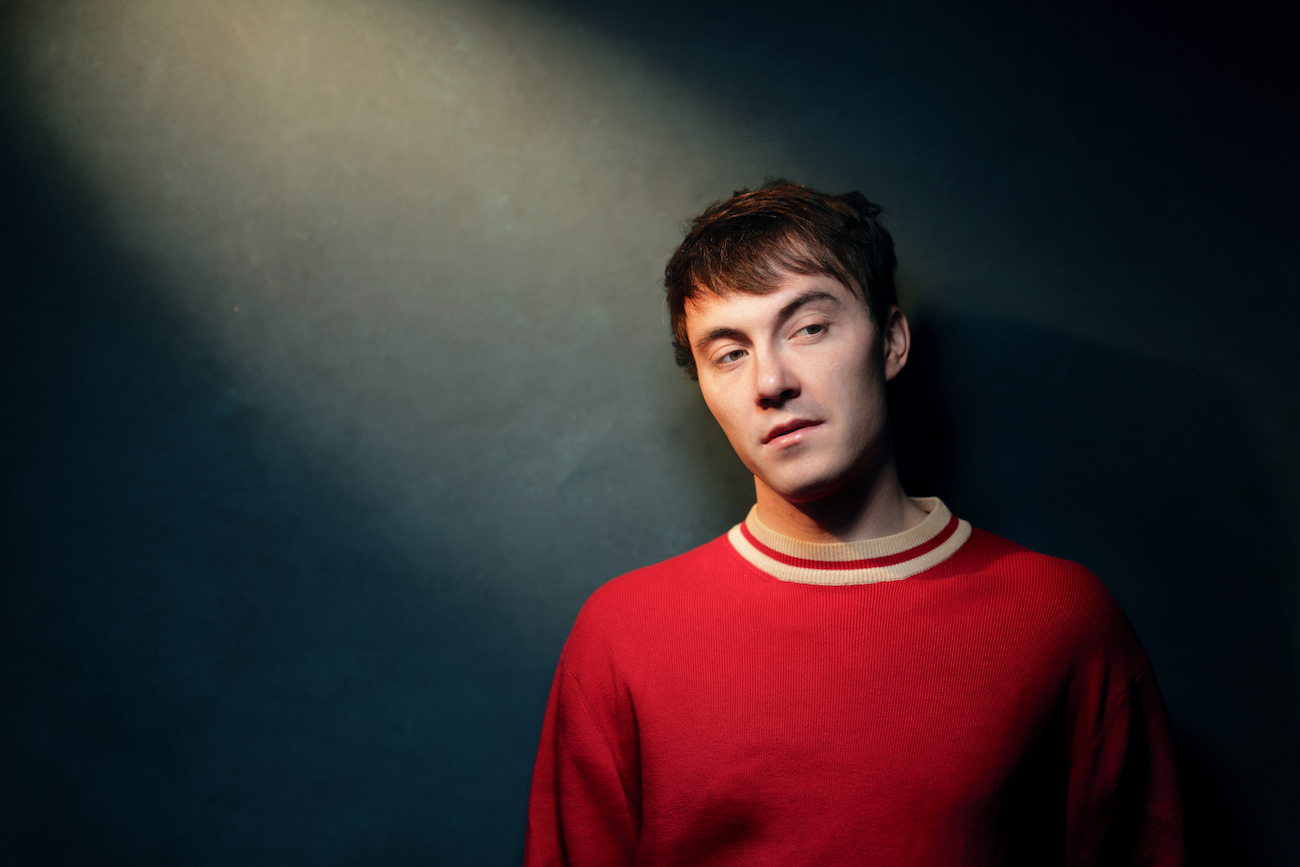
Gay culture is being a teenager in your 30s because your teenage years were not yours to live. The widely shared quote is echoed in Sam Obrist’s “Late Bloomer,” which kicks off his discography by way of his 2023 debut, River Rising. “Every single tear that I now cry / Directed to the boy that passed me by,” he laments over undulating guitar riffs and languid, springy drums. “If I could talk to him and tell him, / “Don’t be scared and live your life.” It’s a sentiment many gay — and indeed, queer — people would find relatable for its sheer veracity: years spent hiding could have so easily been years spent … just living.
“[“Late Bloomer”] is all about how I personally feel the realization of my sexual orientation was late-in-coming and how I feel an urge to make up for the many years of being unaware of it,” says Sam. “This making up for lost time, I believe, resulted in a complicated relationship to sex that sometimes spirals into an unhealthy obsession. To go from never considering myself an option on the sexual market to, all of a sudden, becoming one was an exciting and bewildering time which has led to the reflections within that song.”
Although you would think that a “gay, New York City-based musician” might skew more urbane, hedonistic, pop with a capital P aesthetically speaking, Obrist’s oeuvre is quiet and unassuming, replete with folk-leaning concoctions deeply steeped in the natural world as it is in the exploration of the heart and the mind.
Imbued with huge dollops of warmth and sincerity, listening to Obrist’s music — and I have caught Obrist live multiple times to attest to this quality — is quite akin to getting a check-in from an old friend on where he’s been in life and where he’s going. A cursory listen would also immediately reveal a direct throughline from the likes of Neil Young, Joni Mitchell, Paul Simon, The Beatles, Elliot Smith, and of course, Nick Drake, all of whom Obrist has acknowledged as influences.
In an exclusive chat with ATC Sound, Obrist delves deep into his Syracuse upbringing, his day job as a music teacher, navigating a creative life as an artist in New York City, and why he doesn’t really chase commercial success.
A Conversation With Sam Obrist
ATC Sound: The natural world seems to be a pervasive theme in your music: your first album is called River Rising, your second Beneath the Sun. A glance at your social media also indicates that you spend a lot of time outdoors. There’s also a sense of airiness and openness in the way your music is produced that conjures up the feeling of being in nature. What endears the natural world to you so much that it keeps showing up thematically and atmospherically in your musical output?
Sam Obrist: I grew up in rural New York on the shore of a river, about a thirty minute drive north of Syracuse. My upbringing was colored by a love of nature as I was keen on doing anything outdoors with friends: fishing, rope swinging, swimming, sports, fort building, etc. So I think it all comes back to the environment of my upbringing, having grown up on a river and within woodlands.
I had nothing else to do except spend time outdoors with my childhood friends. My family is very outdoorsy as well which resulted in lots of hikes in the Adirondacks, fishing and camping trips and things of that nature. I was definitely a child of nature, which led me to become an Eagle Scout later in my teens, giving me the opportunities of monthly camping trips.
I think living in New York City and feeling so detached from the idyllic scenes of my youth has influenced my lyrics a lot. River Rising feels like a longing and an aching for nature as I was moving around a lot within the city after breaking up with my boyfriend. Beneath the Sun is more of an appreciation and celebration of the glories of the outside world. I was more connected to nature during this time, making a greater effort to get out of the city and to spend more time outdoors.
ATCS: There’s a track in River Rising called “Song for Introverts” that made me chuckle. What made you come up with an anthem of sorts for introverts?
SO: I like to think of “Song for Introverts” as a bit quirky. I wrote it while staying at home while many of my friends in the music community were out socializing. The first two verses are an anthem and a celebration of introversion in a sense, with the message that it’s okay to be on the wings of the party so to speak. The third verse is a bit heavier for me with the idea that sometimes being introverted can result in missed opportunities.
ATCS: Moving on to Beneath the Sun, “The Photograph” is one of my favorite cuts from you — it sounds quite spectral and lush. What can you tell me about writing and producing that cut?
SO: It was inspired by a photograph of Joni Mitchell playing guitar in Cass Elliot’s backyard with David Crosby and Eric Clapton sitting nearby. It gave me a profound sense of longing to have been born in a different time when things were simpler and life more tranquil. I wanted to step inside the photograph. It’s a feeling I’ve carried for a while because much of the music I love was made during the lost past and I often wonder what it would have been like to grow up during the Summer of Love when all this new and vibrant music was affecting culture. I rarely play “The Photograph” because I never felt it had a cozy spot in my sets.
ATCS: Speaking of sets, the acoustic guitar is such a vital part of your music and public persona. What made you pick it up in the first place? I remember Joan Armatrading saying something along the lines of how the guitar feels so intimate to her because you have to physically hold it close when you’re playing it and despite having played it for decades, there always seems to be something new to learn about it. Do you feel this way about the instrument?
SO: Absolutely. I love the fact that the music radiates within the cradle of my arms rather than, say, from an amp. I love the woody warmth of acoustics which perhaps stems from my love of nature. Growing up, I played acoustic guitar around the campfire with my cousin and uncle — and many times alone — during our yearly retreats into the Adirondacks. This definitely played a role in my love for the instrument. Lastly, I am deaf in my right ear so perhaps having the ability to hold my left ear close to the body of the instrument and to hear all the subtitles of timbre between strings has had an effect.
ATCS: What compelled you to take on this music-making path? Was there a specific turning point that made you go, “OK, this is what I have to be doing in life”?
SO: I’ve been writing songs since I was ten and in high school, I actually put together a studio-recorded twelve-song album! I never partied, did drugs or explored my sexuality which, while perhaps sounding good on paper, gave me a sense that I missed out on important social experiences and experimentations as I first enrolled in the University of Buffalo, where I majored in English and Sociology.
It was in college that I learned a great deal about who I was and what I wanted in my friendships. My closest friends were musicians who I lived with off-campus and played with regularly, friends who played a huge role in the development of my music tastes. By the end of it all and as a new phase in life approached, I had an epiphany where I realized that I didn’t want to do anything besides music. I wasn’t ready to face down that deep-seated feeling until I absolutely had to make the jump.
So I moved to New York City thinking I would pursue jazz before quickly settling into writing and performing my own songs. It was here that I continued to learn about myself, specifically my sexual orientation as a gay man.
ATCS: What prompted the move to New York City? Did the city turn out to be what you had assumed/expected it would be, especially in terms of cultivating an artistic life?
SO: New York City made the most sense to me because it wasn’t too far from home yet feels like a wholly different country. I had zero expectations upon moving, acting in a purely spontaneous manner with the mindset of figuring it out as I go. It was incredibly hard to adapt to the lifestyle here at first but I managed to find my footing. But I began as a loner of sorts, honing in on my craft and sheltering myself from any community of artists, until I started playing open mics. The open mic circuit was great for me because I then found a community of artists and learned how to gig regularly.
Now, being a creative is all about staying grounded in my artistic visions and to not get so caught up in the monotony of the day-to-day. Finding the balance between letting the mind play and forcing it to focus on the crafting of the work is what I strive for. The community I found is immensely important. Being social with like-minded people — discussing art and gigging — holds me accountable to my work and to stay with it against all odds. Many times people will ask if I’m playing anywhere soon or how the recording is going. Questions like these are excellent motivators for me.
ATCS: How does being a music teacher inform your approach to writing and singing and complement your singer-songwriter self?
SO: Many times my students and I will stumble into songs that influence my writing. A lot of my students over the years have enjoyed learning what makes certain songs special and how music theory can inform the emotions we feel upon listening. Teaching this repeatedly and with the context of many different songs have allowed me to adopt some of these practices within my own writing. Teaching also allows me to have a guitar in my hands for large portions of the day which enhances my playing and sometimes inspires ideas. Being around music throughout the day, I believe, can only have positive impacts on my writing. Lastly, teaching affords me the time and space to work on my own stuff because it isn’t too time consuming and I have the flexibility to make my own schedule.
ATCS: What’s next for you? Where would you like to go artistically, musically, personally, and professionally?
SO: Another album is and always will be next for me as far as I can tell. Writing songs is my favorite part of what I do. There’s a song on Beneath the Sun called “The Way Down,” which is a departure of sorts, being a piano ballad. I’d like to have more of these. I really just need to sit at the piano more and be okay with the fact that it’s not my first instrument.
I will certainly tour. I do want to plan some touring stints in the near future but haven’t decided what that will look like in terms of whether I’ll be solo or with a band or what music I’d like to bring on the road. I thrive in a solo setting so I’m more than happy to continue doing that but maybe not full time. Being in a band is something I’d like to explore more and I would eventually like to find people that I can create with. I feel a bit uncomfortable having friends play my music and organizing the ins and outs of rehearsals. It feels forced sometimes. I want to find something where people play with me and create with me because they want to and because we see a greater purpose in doing so. I try to remind myself of these opportunities of collaboration when I’m out socializing but I don’t want to rush it.
I’m definitely eager to play extensively outside of NYC soon. I don’t really chase commercial success in the same way others have the motivation to do. It’s much to my detriment that I don’t devote more time to this but it’s always been a struggle balancing an artistic life with the practice of promoting myself. I hope to find joy in this practice someday. Until then, I’m happy to stumble into commercial success.
As far as critical success, I’ve always been a bit suspicious of those who call themselves critics — maybe also to my detriment — so I’m not too concerned with critical opinions. Then again, I’ve never had Pitchfork evaluate me so I’d imagine my opinions could change. I just hope my music can continually make somebody somewhere feel better.
* * *
Submit Your Music To ATC Sound For Review
If you are an independent artist and would like your music considered for review by ATC Sound, please submit your song/project (released or unreleased) via our free submission form.